
Two nearby gyms can look similar until you check whether one is open after your shift or has the equipment you need. In the LA Fitness vs 24 Hour Fitness decision, your budget, schedule, training style, and preferred amenities matter more than the logo.
A club tier is a facility level assigned to an individual 24 Hour Fitness club that affects its equipment, amenities, and membership access. That matters because clubs in the same chain may offer different features and access.
This comparison helps you judge which nearby club fits your routine and what you would pay to use it. Start by comparing the real cost of joining, not just the advertised monthly price.
Key Takeaways
- Compare the clubs you can reach, not just the chain names.
- Check upfront charges as well as monthly dues.
- Confirm a 24 Hour Fitness club’s tier, hours, and amenities.
- Choose based on your workout priorities and schedule.
- Read access and cancellation terms before you sign.
LA Fitness vs 24 Hour Fitness: What Do Memberships Cost?
LA Fitness lists monthly dues of $34.99 plus taxes, while 24 Hour Fitness lists rates from $35 to $56.99. Fees can change the real total, so those monthly prices alone do not show what joining costs.
For a useful LA Fitness vs. 24 Hour Fitness cost comparison, add the first-month charges and recurring costs. LA Fitness lists a $49 initiation fee for both memberships; its Multi Club plan also has a $49 annual fee. Paying the first month, last month, and initiation fee makes the listed upfront cost about $119 before taxes.
Compare the first-month charges and recurring costs, not monthly dues alone.
| Cost item | LA Fitness | 24 Hour Fitness |
|---|---|---|
| Monthly dues | $34.99 plus taxes | $35-$56.99, depending on location and plan |
| Initiation or startup fee | $49 initiation fee | Varies by location and plan |
| Annual fee | $49 Multi Club; none for Single Club | $49 for most memberships |
| Prepaid Costco option | Not listed | About $429.99 for two years, listed July 2026 |
LA Fitness Single Club costs the same listed monthly amount as Multi Club but has no annual fee. Promotions may waive the initiation fee. At 24 Hour Fitness, the monthly fee depends on the plan and location, and most memberships have an annual fee.
A Costco prepaid 24 Hour Fitness All-Sport membership was listed at about $429.99 for two years in July 2026. It covers Sport-tier clubs and below, with no startup or annual fee. Confirm acceptance with both Costco and your local club before buying. 24 Hour Fitness has temporarily rejected Costco certificates, including in August 2023.
These are listed examples, not guaranteed quotes. Location, taxes, plan details, and promotions can change your total. Check membership terms and access options before committing to a price.

What Membership Terms and Access Options Differ?
If your work commute takes you past two gyms, access to more than one club could save time. The plan determines where you can work out, while contract length determines how long you commit.
24 Hour Fitness offers single-club, regional-access, and national-access plans. LA Fitness offers Single Club and Multi Club memberships. A plan that allows visits to multiple clubs is not automatically an unlimited national plan.
- Single-club access: confirm which one club your membership includes.
- Regional access: check the exact area and participating clubs.
- National access: confirm the locations covered by the plan.
- Contract length: compare the term with how long you expect to stay.
24 Hour Fitness contract options include month-to-month, one-year, and two-year agreements, plus one-week, one-month, and three-month short-term options. LA Fitness offers month-to-month, six-month, and annual contracts. Available memberships and terms can depend on the club.
Read the agreement for the exact access radius or participating clubs, and ask how the rule applies when you travel. The membership scope matters as much as the month-to-month commitment, and the 24 Hour Fitness club tier can also affect what you find inside.
How Does Equipment Compare at Each Club Tier?
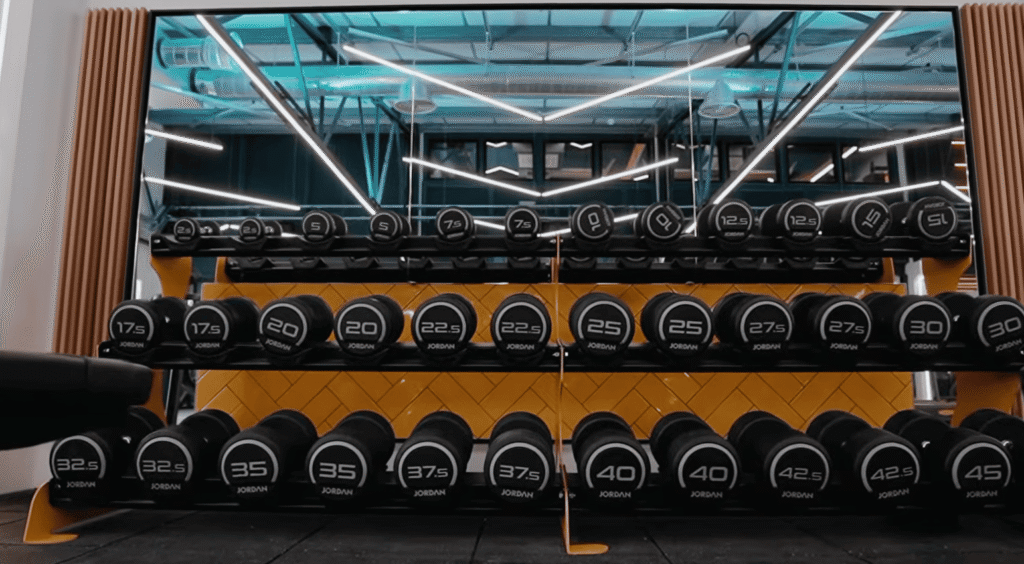
A lifter seeking branded bumper plates may prefer a higher-tier 24 Hour Fitness club; someone who needs heavier dumbbells may favor LA Fitness. The local setup matters, since equipment varies by location and club tier.
Sport-tier 24 Hour Fitness clubs and above offer Rogue and Eleiko barbells and bumper plates. LA Fitness standard clubs generally have standard barbells and plates. General strength training does not require premium equipment brands.
Free weights and strength-training equipment
Rogue and Eleiko are premium strength-training brands. In a search for “bumper plates rogue” or “rogue eleiko,” you may be looking for those specific brands, but the right fit depends on your training, not the label alone.
| Equipment or rule | 24 Hour Fitness Sport and above | LA Fitness standard clubs |
|---|---|---|
| Barbell and plate brands | Rogue and Eleiko | Standard barbells and plates |
| Dumbbell ceiling | Typically 100 pounds | Up to 120 pounds at most clubs |
| Racks and platforms | Multiple squat racks and lifting platforms | Squat racks and deadlift platforms at most locations |
| Chalk or dropping weights | Chalk and dropping weights allowed on platforms | Chalk at most clubs; dropping weights discouraged |
LA Fitness’s higher dumbbell ceiling can help if your workouts depend on heavy dumbbells. For general hypertrophy training, standard barbells and plates may be enough. Competitive powerlifting or Olympic lifting can make platforms, bumper plates, and club rules more important.
Functional training and lifting rules
Some 24 Hour Fitness clubs also have turf areas for functional training. Chalk and dropping weights are allowed on platforms there, while LA Fitness discourages dropping weights. Check the club tier and equipment in person, because clubs in one chain can differ.
A walkthrough can show whether the racks are available during your workout time and whether the rules suit your lifts. After checking training equipment, consider which amenities would make the club practical for the rest of your routine.
Which Amenities Can You Use, and What Costs Extra?
A parent choosing between two gyms may care as much about childcare as the workout floor. Check the exact club, because pools, basketball courts, and other amenities are not guaranteed at every location.

Both chains have pools and basketball courts at some clubs. Both also have racquetball courts, showers, and locker rooms at some locations. 24 Hour Fitness clubs may offer saunas, childcare, juice bars, or pro shops; LA Fitness clubs may have smoothie bars and saunas.
- Pool: ask whether the club has one and when it is open.
- Basketball court: check access and whether reservations are required.
- Sauna: confirm that the location has one and check its hours.
- Childcare: ask about eligibility, operating hours, and charges.
Childcare is available at participating clubs, but its price and availability need a local answer. One account describes childcare at most participating LA Fitness clubs as included; another describes a monthly fee. 24 Hour Fitness charges extra for childcare at Sport and Super Sport levels.
Ask the club directly about childcare eligibility and charges before relying on it. Some LA Fitness sports-court reservations also cost extra, so ask about booking fees before planning a regular game. These details can affect your actual gym routine and budget.
Once you know which amenities are usable, check the club’s access hours, especially if you work early mornings or late nights.
How Late Can You Work Out at Each Chain?
Only select 24 Hour Fitness clubs provide true overnight access. The name does not promise round-the-clock entry: weekend hours may be shorter, and Fit-Lite or Express clubs often keep standard schedules.
Most LA Fitness clubs close between 10 p.m. and 11 p.m. on weekdays and at 8 p.m. on weekends. LA Fitness does not operate clubs with standard 24-hour access. Check the schedule for the specific club you plan to use.
| Schedule detail | 24 Hour Fitness | LA Fitness |
|---|---|---|
| Typical weekday hours | Standard hours at many clubs; select clubs open 24 hours | Most clubs close between 10 p.m. and 11 p.m. |
| Typical weekend hours | May be reduced | Most clubs close at 8 p.m. |
| Overnight access | Select higher-tier clubs in major metro areas | No standard 24-hour access |
| Important location exception | Fit-Lite and Express clubs often keep standard hours | Hours vary by location |
Weekend schedules or a lower club tier can remove the apparent advantage of 24 Hour Fitness. A late-night option is useful only when its doors are open at the time you arrive, not just because the chain’s name suggests it.
A schedule advantage matters only if the club is close enough for regular visits. Compare the hours you can use with the locations available in your area.
Where Are the Clubs, and How Can You Check Nearby Locations?
A member in California may find several 24 Hour Fitness clubs nearby, while someone in Florida may have more LA Fitness options. Your state changes the choice, so check local locations rather than assuming the same chains operate everywhere.
24 Hour Fitness is concentrated in California and also operates in Texas, Washington, Oregon, Colorado, Nevada, and Hawaii. An early 2026 count listed 167 California clubs. Its 2025 club counts are dated estimates, not a guaranteed current total.
Where 24 Hour Fitness operates
One 2025 snapshot counted 244 24 Hour Fitness clubs across nine states; another 2025 estimate put the US total at about 300. These figures differ, so treat them as estimates from that year, not a live count. 24 Hour Fitness has no Canadian clubs.
Where LA Fitness operates
LA Fitness has more than 500 US clubs across more than 20 states, including California, Florida, Texas, Illinois, Arizona, New Jersey, and Georgia. It has wider geographic coverage across US states and also operates clubs in Ontario, Canada. 24 Hour Fitness members have reciprocity at GoodLife Fitness and Energie Cardio in Canada.
How to check 24 Hour Fitness near me
Search “24 Hour Fitness near me,” then use the official locator to check the nearest club’s tier, hours, and amenities. Do not assume the brand name guarantees 24-hour access. Confirm that the listed hours fit your schedule and that your plan includes the club.
Once you confirm a nearby club, compare its classes with the workouts you want to do.
Which Group Classes Fit Your Workout Routine?
If you stick to a scheduled class more reliably than a solo workout, check the local calendar before joining. A usable class time can help build consistency, but class names and schedules vary by club.
Both chains offer fitness options that can include group workouts. Across the chains, examples include yoga, Pilates, Zumba, spin, and strength training. The exact classes and schedule depend on the location.
- Yoga: a scheduled class for guided movement and flexibility.
- Pilates: a class focused on controlled movements and core work.
- Zumba: a dance-based group workout.
- Spin: an instructor-led indoor cycling session.
- Strength training: a coached group workout using resistance.
Some LA Fitness clubs also offer aquatics or boxing. 24 Hour Fitness schedules may include barre or Body Pump. LA Fitness’s HIIT by LAF is available at some locations for an extra $125 per month, so check whether that added cost fits your budget.
Either chain can support weight loss. Consistency, a schedule you can use, and a sustainable mix of activity matter more than the brand or which fitness offers sound better on paper.
If you want individualized coaching rather than group classes, compare the personal training options before you commit.

What Does Personal Training Cost, and What Credentials Matter?
LA Fitness has the lower listed personal training session range, while 24 Hour Fitness sets a one-year minimum experience requirement. Price and experience are different measures, so look at both when comparing fitness coaching.
24 Hour Fitness trainers must have at least one year of experience and a certification through NASM, ACE, or a comparable organization. Many also have college degrees, but a degree is not required. Certification is required; a college degree is not.
Trainer experience and qualifications
LA Fitness trainers must hold certifications, but the chain has no stated minimum experience or degree requirement. That does not tell you how a particular trainer will coach. Ask about experience with your goals, training style, and any limitations you want considered.
Session prices and package trade-offs
24 Hour Fitness sessions are listed at $85-$97.50 per hour, depending on location and experience. LA Fitness sessions are listed at $45-$60, depending on location and session length, with package pricing available. These ranges are examples; get a local quote.
Compare the session itself, not just the hourly rate. Ask how long each appointment lasts, whether a package changes the price, and what happens if you miss or reschedule a session.
Before you pay, ask for the package terms and cancellation rules in writing. A lower listed cost may suit your budget, while experience may be a priority if you want more established guidance.
A price or credential alone cannot settle whether a specific club is a sound long-term choice. Consider the club’s own status and the terms you would be accepting.
Is 24 Hour Fitness Stable Enough to Join?
24 Hour Fitness has a documented bankruptcy history, then took steps to refinance debt and fund improvements. That history deserves context, but it does not establish what will happen to any specific club.
The company entered Chapter 11 bankruptcy in 2020 and exited in December 2020 after eliminating about $1.2 billion in debt under new ownership. In 2025, it secured a $305 million credit facility to refinance debt and fund capital improvements.
No new wave of closures was reported through the stated timeframe, but that does not establish the company’s financial position as of October 2026. Do not treat past restructuring as a guarantee of future stability.
If you are asking, “Is LA Fitness struggling?” the facts here do not establish LA Fitness’s current financial health. Do not infer it from 24 Hour Fitness’s history or the experiences of unrelated clubs.
Check the specific club’s current status before joining, and avoid a long prepaid commitment unless the terms suit you. Company-level uncertainty is only one consideration; you can also check the club and agreement directly before signing.
What Should You Check Before Joining or Canceling?
If a move or schedule change makes your gym impractical, the cancellation process can affect what you still owe. Read the written terms before you join, not only when you want to leave.
24 Hour Fitness requires cancellation requests in writing, submitted at the front desk or sent by certified mail. It does not charge a cancellation fee. LA Fitness accepts a downloaded cancellation form at the front desk or by certified mail, and also has no cancellation fee.
Cancellation steps and remaining contract costs
No cancellation fee does not always mean no further costs. A member with an annual LA Fitness contract may still owe for unused time. Ask about any remaining contract payments before you cancel.
- Read the cancellation clause in the membership agreement.
- Confirm the club’s form or certified-mail instructions.
- Save a copy of the request and proof it was submitted.
- Ask whether any contract payments remain due.
Guest rules and a useful trial visit
24 Hour Fitness allows one free guest who is at least 18; bringing the same guest a second time has a fee. LA Fitness Multi Club members may bring one guest free, while additional guests on the same visit cost $20.
Try the actual club at the time you would normally work out. Look at cleanliness, crowding, and equipment condition; none is uniform across a chain. A quiet midday visit may not show what the club feels like after work.
Choose based on your own routine and what you observe locally, rather than assuming every location offers the same experience.
Which Gym Fits Your Schedule and Training Goals?
Choose the closer club if both meet your non-negotiable needs; choose the other only when its specific features fit your routine better. The local club is the deciding factor, not a chain-wide reputation.
Use these rules to decide which gym fits your budget, schedule, and training priorities. Travel friction can undermine consistency, even when a farther club looks better on paper.
Choose the closer club when both meet your needs; a gym you can reach is easier to use consistently.
- Choose LA Fitness when its broader local coverage or standard-club amenities matter most.
- Choose 24 Hour Fitness when the nearest suitable club actually offers overnight access.
- Favor Sport-tier or higher 24 Hour Fitness if Rogue or Eleiko equipment is a priority.
- Consider LA Fitness for its lower listed personal-training prices or heavier dumbbells.
- Confirm the exact club’s basketball, pool, childcare, and class options before deciding.
Your location can narrow the choice quickly. If only one chain has a convenient club, a longer drive to the other may cost you time and make regular visits harder.
When both are nearby, think about your training priorities and budget. You may prefer a club with overnight access, or one where the listed personal-training prices suit your plans.
Before paying, confirm the specific club’s current hours, tier, and written membership terms.
Conclusion
There is no universal winner between LA Fitness and 24 Hour Fitness without considering the local club. The best fit is the one you can use consistently, with hours and training options that match your life.
Club tier and location matter more than assumptions about a chain. A nearby club that fits your workout can be a better choice than a longer trip for features you rarely use.
Visit your two closest clubs at the time you plan to exercise. Ask each one to confirm membership terms in writing, then compare the visits and choose the club you can realistically use week after week.